
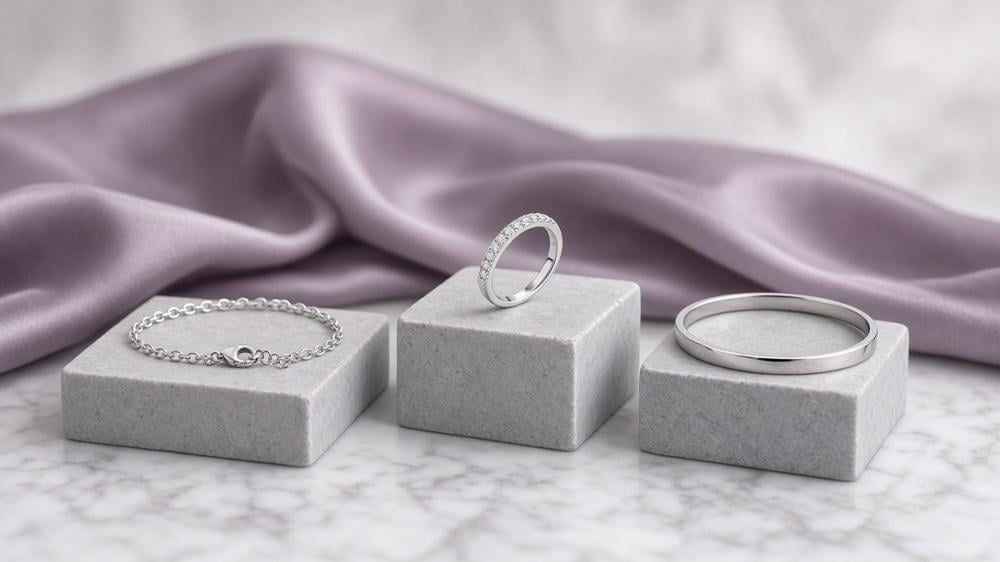
Three pieces, all bright white, with very different prices: silver, white gold and stainless steel. From a distance they can look alike, but they differ a lot in composition, value, care and how they age. This guide compares the three metals clearly, so you know exactly what you are buying and which metal suits your budget and the way you wear jewelry.
In short: 925 silver is a precious metal at a reasonable price; it needs light polishing and is easy to resize. White gold is gold alloyed with white metals and usually rhodium-plated, with much higher value. Stainless steel is an iron alloy that does not tarnish and costs little, but it is not a precious metal and is hard to resize.
◆ 925 sterling silver
Sterling silver contains 92.5% pure silver, with the rest made up of metals such as copper for strength. Many pieces are rhodium-plated for a strong white shine and slower tarnishing.
- Pros: a precious metal, a beautiful shine, a reasonable price, easy to polish and resize.
- Cons: it may dull with air and humidity, and it is softer than stainless steel, so it can scratch.
◆ White gold
White gold is real gold alloyed with white metals such as palladium, nickel or silver to lighten its color. 18K contains 75% gold, and 14K about 58.5%. Because its natural color has a slight warmth, it is usually rhodium-plated to give the familiar bright white shine.
- Pros: the value of gold, no tarnishing, very long-lasting.
- Cons: a much higher price, plating that wears over time and needs redoing, and some types contain nickel, which can cause allergies.

◆ Stainless steel
Stainless steel is an iron alloy containing at least 10.5% chromium, which protects it from rust. The most common grade in jewelry is 316L. Its color is a silvery grey, slightly darker than silver.
- Pros: does not tarnish, very hard and scratch-resistant, low price.
- Cons: not a precious metal, so its value lies only in the design; very hard to resize; and it contains some nickel, although it is bound within the alloy.
◆ Quick comparison
| 925 silver | White gold | Stainless steel | |
|---|---|---|---|
| Precious metal? | Yes | Yes | No |
| Price | Reasonable | High | Low |
| Tarnish | May dull, polishes easily | Does not tarnish; plating wears | Does not tarnish |
| Scratch resistance | Moderate | Moderate to good | High |
| Resizing | Usually easy | Possible at a jeweler | Very difficult |
| Weight | Medium | Heaviest | Lightest |
| Care | Polishing and sealed storage | Re-plating from time to time | Minimal |
◆ Rhodium-plated silver: the middle ground
If you love the look of white gold but the budget does not allow it, rhodium-plated silver is the closest alternative. Rhodium is a white metal from the platinum family, and it is the same plating usually used on white gold, so you get a very similar shine with a precious metal underneath at a much lower price.
- The plating noticeably slows silver tarnish.
- It wears with friction and time, especially on rings, and a specialist jeweler can re-plate it.
- It needs gentle care without abrasives; details are in our article on caring for plated silver.
◆ Which one suits you?
- You want value and a premium look at a reasonable price: 925 silver, especially rhodium-plated.
- You want an investment piece or a shabka: white gold.
- You want a tough everyday accessory for sports or manual work: stainless steel can be practical.
- You have sensitive skin: 925 silver is a good choice for most people; more details in our article does silver cause allergies.

◆ Why resizing matters so much
A ring you love may become tight or loose over the years. Silver is a workable metal that a jeweler can size up or down within limits, and white gold can be resized too, followed by re-plating. Stainless steel, however, is so hard that resizing is very difficult, and the usual solution is to exchange it for another size. So before buying any ring, confirm your size with the size guide.
◆ How to tell them apart in a shop or online
- Read the stamp: silver is usually stamped 925, white gold 750 or 585, and stainless steel may be marked 316L or Stainless.
- Read the description carefully: "925 silver, rhodium-plated" is not the same as "silver-tone plated metal".
- Compare the price: white gold costs clearly more, and a very low price for "white gold" is a red flag.
- Look at the color: stainless steel is slightly darker, silver has a warm white, and plated white gold is a strong bright white.
For ways to check genuine silver, see our article how to tell if silver is real.
◆ FAQs
Is white gold better than silver?
Its value is higher because it is gold, but 925 silver gives a very similar look for much less. The choice depends on your budget and purpose.
Does stainless steel tarnish?
No, good stainless steel does not tarnish or rust in normal use, but it is not a precious metal.
Does rhodium-plated silver look like white gold?
Very much, because white gold itself is usually rhodium-plated, so the surface shine is similar.
Which metal is best for allergies?
925 silver suits most people, as does nickel-free white gold. Nickel is one of the most common causes of allergies.
Can I mix silver and white gold?
Yes, easily, because their colors are very close, especially when the silver is rhodium-plated.
Read also:
◆ 925 vs 999 vs S925 Silver: Which Is Best for Jewelry?
◆ 925 Sterling Silver: Everything You Need to Know Before You Buy
◆ Men's Silver Rings: How to Choose the Right Width, Design and Size
A clear choice, no confusion
Genuine 925 sterling silver jewelry with a white shine at a reasonable price.